
I am part way through an Open University degree, combining Design, Computing and Social Sciences into an interdisciplinary Open Degree, with particular focus on digital society and accessible and inclusive design.
Playful Accessibility
Accessing nature with creative tech
"All human beings have limitations when it comes to accessing nature. We can’t crawl in soil like a tiny worm, enter small habitats or fly in the trees like birds."
Garden Lab Whispers Grow: Grounding Technologies
Can Tech Help Us Get Closer to Nature?
Shado Mag Article about Garden Lab and other Grounding Tech projects
Following on from the Garden Lab I was selected as a participant in the Friends of the Earth AI Community Environmental Action Lab. This gave me time and space to explore ways of using AI and sensor technologies to access nature from the perspective of other living beings.
Printing with Access Aids
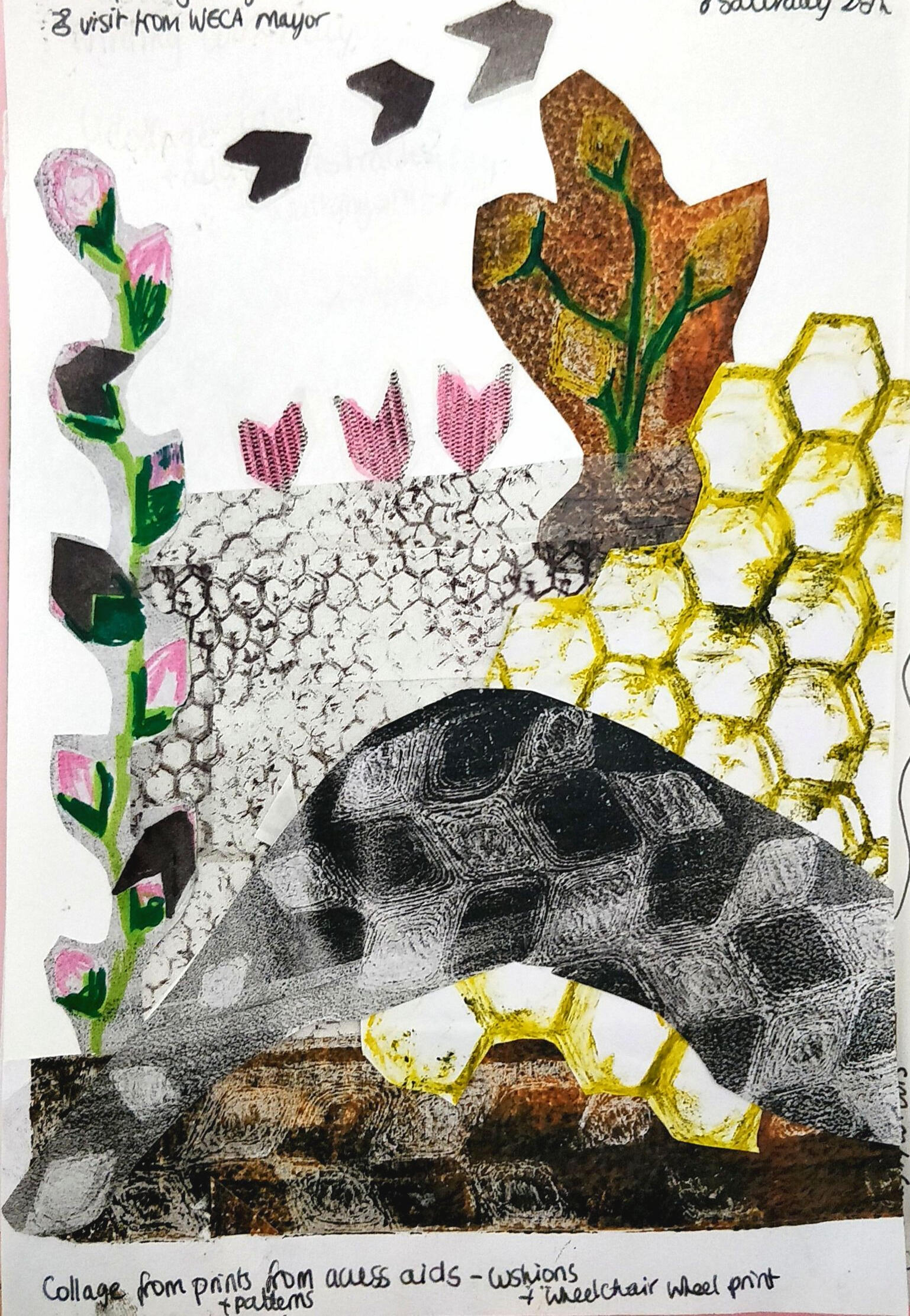
This experimental art project began with printmaking using disability aids, because whilst printing I noticed my support cushions and stick had cool textures. This led to rich conversations with other people about their aids from a different light, without so many preconceived ideas.This collage combines prints from my aids alongside prints from my friends wheelchair wheels, to represent how our aids interact with accessing nature. Using a piece of children's train track, I also used printing to explore my feelings and fears about my barriers to train travel.
A small commission to support the Knowle West Lights Lights Lights project around accessibility. I explored different ways disabled people experience and perceive the Christmas lights and wanted to explore some of the wisdom and creativity that come from that. This led me to develop these disability wisdom glasses, along with prototypes and resources exploring in-person and digital accessibility.
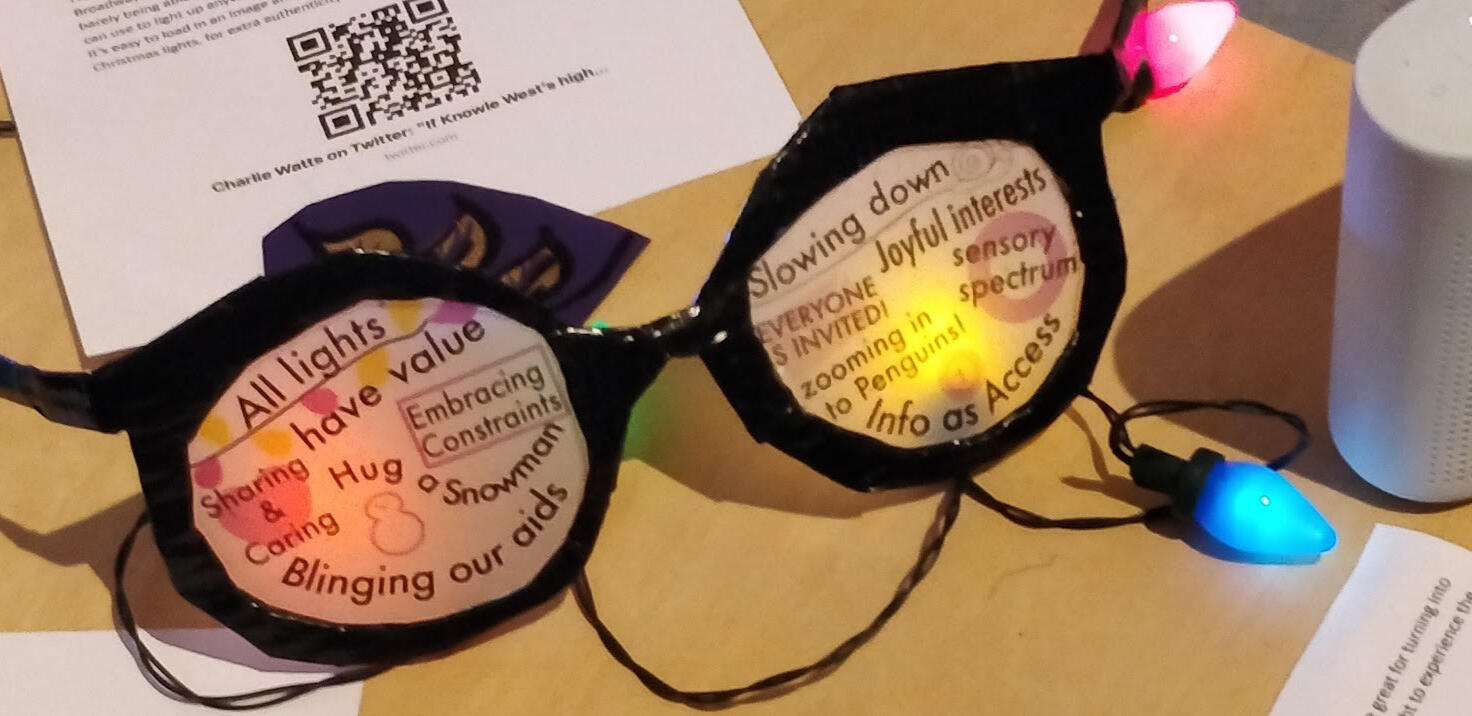
The vellum lenses in the glasses contain the following phrases and graphics
Left lens:
All lights have value - with a yellow and purple light graphic
Sharing & caring - over a heart shape
hug a snowman - with a basic snowman graphic
Blinging our aids
Embracing Constraints - with a rectangle around it.
Right lens:
slowing down - with a snaily trail underneath and a snail graphic
joyful interests - underneath a snail graphic
Sensory spectrum - with a donut / no entry style red circle underneath
Everyone is invited - over a DIY envelope style graphic
zooming into Penguins!
Info as access - with pink i symbol

Prototype Knowle West lights flipbook, inspired by the constraint of light sensitivity

Viewfinder to help zoom in to details and reduce sensory overwhelm


Creative Activism
Work looking at systemic change using creative methods
Housing Welcome Box
Made as part of Future Makers at KWMC The Factory, for a We Can Make Homes (community built housing) brief.I considered both We Can Make residents and the wider housing crisis. Drawing on my lived experience of being place in emergency accommodation and my frustration around the lack of care and consideration in my housing and the wider system of emergency and temporary accommodation, I explored:
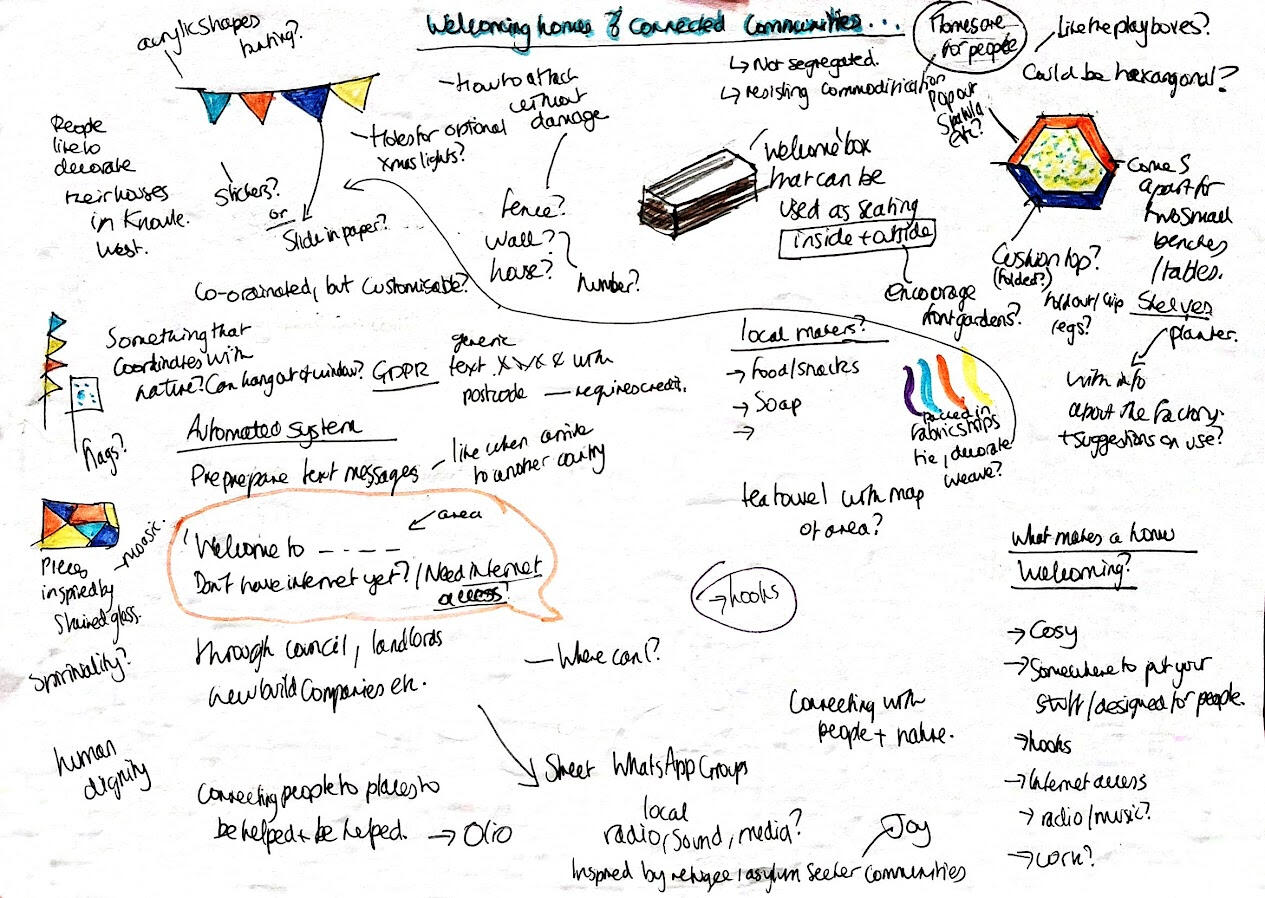
What could make housing feel and BE a welcoming home?
Creative ways to connect people and their environment into communities...
Drawing on my own and friends' experiences in temporary accommodation, social housing and asylum accommodation and inspired by We Can Make housing, I wanted to imagine and create something different. Something driven by hope and care, that centres those on the margins and builds solidarity between those affected by the housing crisis in different ways.
This resulted in a prototype housing welcome box, that centres the people living in housing and allows communities to welcome new people to their communities and also as a form of imaginative activism.
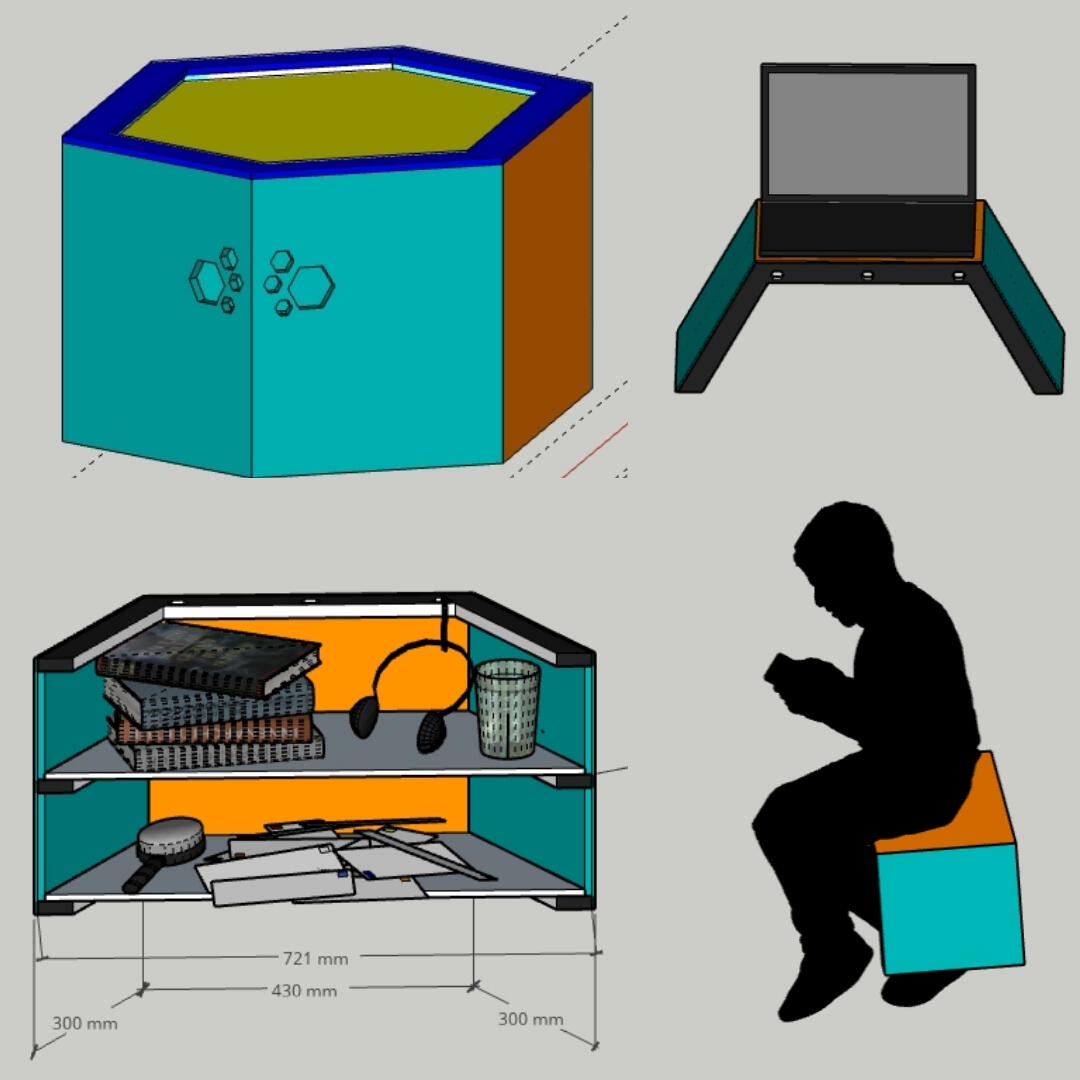

Prototype in stool / laptray configuration

half hexagon wooden prototype with shelf and hexagonal holes at the edges

Prototype box at Filwood Refugee Festival Picnic


Exploring Housing Systems
Studying Web Technologies without a place to call home, I started documenting different online barriers and systems I was experiencing. This was both a method to raise awareness, but also a way of detaching myself somewhat from the distressing and upsetting systems I was navigating.
Live tweeting my way through trying to register to vote with no fixed address
Content Design and the Cost of Living Crisis talk with Jack from Scope (Disability Charity)
Exploring Experiences of Housing Systems through Games (early prototyping funded by SPIN Labs) - Details below
When you are going through homelessness it often feels like you are playing a cruel game where you don't know all the rules. There is so much hidden, secret and misinformation out there and you can often feel blamed for doing badlyThis project stemmed from learning about systems thinking and system mapping and the subjectivity of systems based on perspective. I wanted to explore how our lived experiences of housing insecurity and homelessness can be explored and shared in a way that puts a focus on the systems we encounter and are part of, rather than more individualised stories or quantative statistics.Having completed some early prototyping and testing we are looking for opportunities to develop this further.
Video shows a paper prototype dice showing being rolled showing - join a waiting list, need more evidence, yes and now do these urgent steps...
UK Asylum Process Hopscotch
I made this game to play at Bristol Celebrating Sanctuary Day and also took it touring other community events.It was designed to raise awareness of the difficult UK Asylum Process. It was play tested and further developed with members of Bristol Refugee Rights, who had lived experience of this process.It is played like hopscotch, but there is also a spinner to spin before each go, this represents different things that can happen in the process. The choices on the spinner are:
No Access To English Classes: Play the next go with your eyes closed.
Meet a new friend at the welcome centre: Ask a new friend to take your go.
Keep Going (x2)
Long Wait: Unfortunately there has been a delay, please throw the bean bag to the same spot again.
Detention: You have been detained, please come back later to continue.
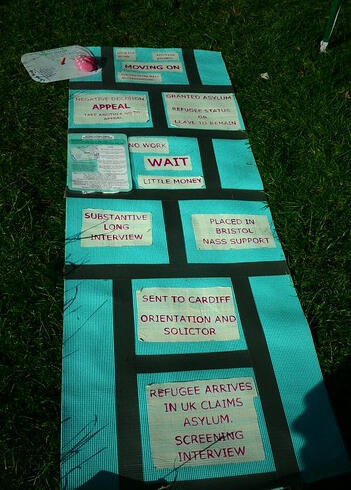
Asylum process hopscotch squares
Refugee arrives in UK. Claims asylum. Screening interview.
Sent to cardiff. Orientation and solicitor
Placed in Bristol - NASS support
Substantive long interview
Wait. No work. Little money.
Negative decision appeal take another spin to appeal.
Granted asylum
Refugee status or leave to remain.
Moving on, apply for benefits, look for accommodation and find work
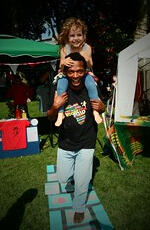
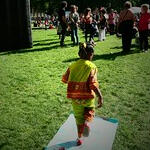
It was really fun and opened up conversations both with those who had been through the process and those who didn't know anything about it.People found it frustrating to have to stop in the middle of the game because they were detained and that opened up discussion about how living with this possibility affects people.Some people who didn't want to play, but they engaged by reading and discussing it, including with those with lived experience and watching others play.
Forum Theatre about Bus Accessibility in Bristol
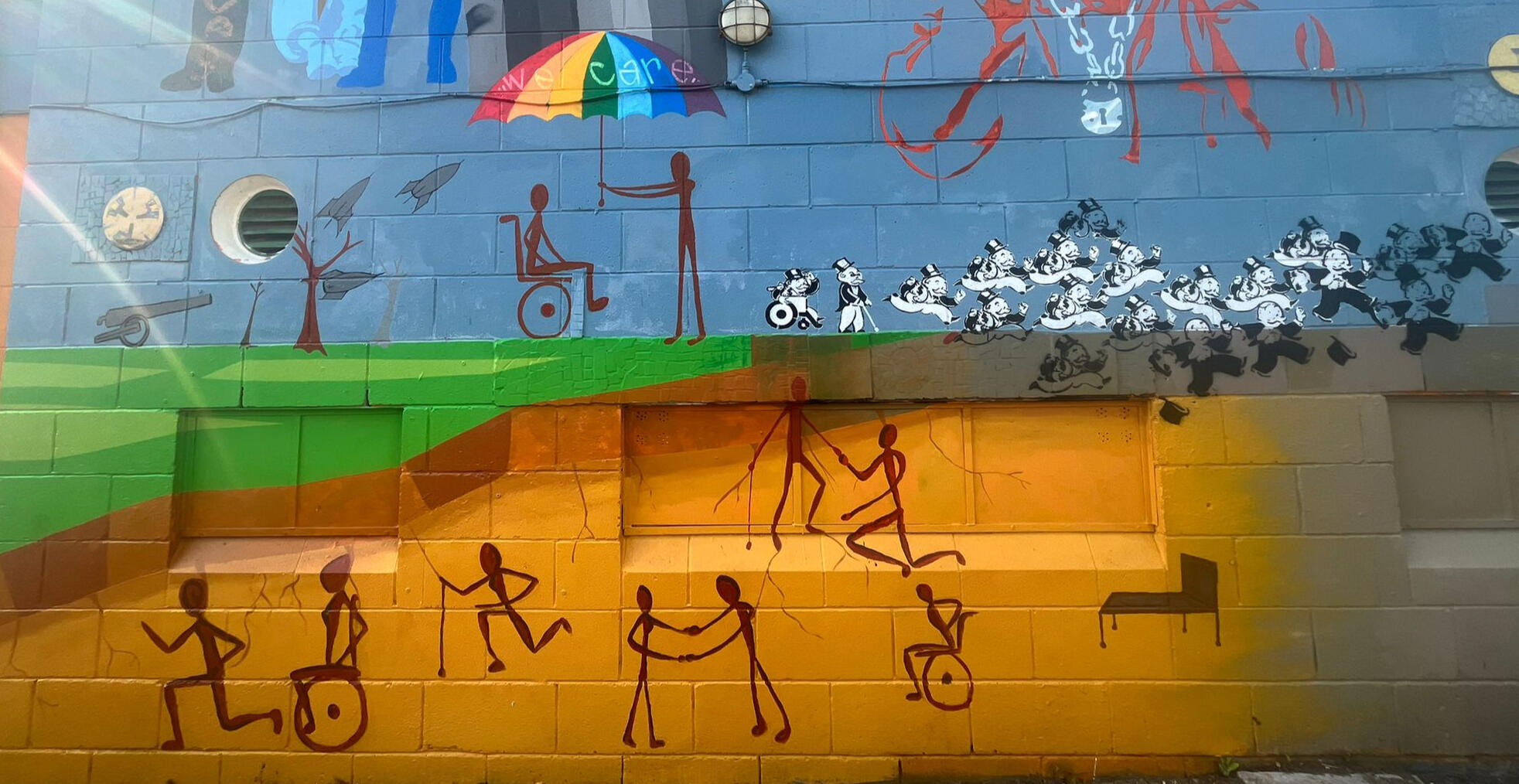
Sensing Climate Mural
Made stencils old plastic packaging to make capitalists spoiling the earth for a local disabled people's climate action mural, highlighting care for people and planet.
Digital
I like to combine my digital skills with lived experience, both mine and others. I am interested in the ways digital technologies allow us to resist and build alternative ways of doing things, even within the existing systems and structures.This has led me to build my own degree to explore this in an interdisciplinary way, including web technologies, digital sociology and IT systems design.
Digital Accessibility
I began building up technical knowledge about digital accessibility through studying a Web Technologies module as part of my Open Degree. It was particularly interesting to me as a disabled person, with disabled family members, including my Mum who is visually-impaired and describes images of text as 'the bane of her life'.The final project was really interesting, involving designing an accessible backend interface for the management of a walking club. Whilst the focus was on making the interface useable and accessible, with particular consideration for those using screen readers and assistive technology, I started to consider access to the walks themselves. This led me amend the design to request and display access information that walkers and walk leaders needed, and to explore the GDPR regulations around this.I enjoyed the process of accessibility testing and thinking about the human impact of technical choices and have continued to develop my skills in digital accessibility, in particular learning and sharing different skills around social media accessibility.
- 2021 - I resolved to write image descriptions on twitter and didn’t look back!
- My list of Accessibility (a11y) resources for technical beginners
I ran a session on 'Making your Social Media more accessible' at Bath Digital Festival (October 2021)
Inaccessible image graphic made for Bath Digital Festival
Live-IT EU Cognitive Accessibility Project (2022)
I participated in the Live-IT projects co-creation hackathon events across 4 partner countries, drawing on my digital accessibility and design skills and my own lived experience with a cognitive disability. Both of these mini ideation projects won prizes.

mocking up an adobe liquid mode chrome extension

Exploring a more accessible user journey through the Live-IT toolkit


Bristol 2014 Digital Storytelling
Exhibited at the Mshed as part of marking the 100th anniversary of the start of World War I.
I joined this Learning Communities Digital Stories Project when it was part way through. I provided tech support for refugee digital storytellers, who were telling stories about conflict. Structuring the narrative and gathering assets was proving difficult for the storytellers so I helped set people up with Padlet timelines to plan out their stories and resources.

Padlet timeline

Peace and Sanctuary

Kurdistan amongst Truth and Dreams

Thousands of Kurdish men were conscripted to fight in World War I


For most of the videos I worked on, we used Adobe Spark Video (now Adobe express video maker), but we also used other movie editing software and even PowerPoint animations to help storytellers realise their vision. Where I edited audio I used Audacity. I edited a couple of audio only stories and I think about 4 or 5 videos.Helping the storytellers tell their stories the way they wanted, whilst trying to ensure the stories were clear and understandable enough for the exhibition meant we had to make choices together. Where someone couldn't pronounce a word they wanted to use or their accent was strong, we worked together to consider whether we wanted to leave it, add text or rerecord different or clearer speech.Given the topic, some of the recordings and collaboration needed to be done sensitively, so we used a quiet room away from everyone else. In one case the person wasn't able to say what they wanted to share, because it was too upsetting. We discussed together other ways to share it and check what they were comfortable sharing, given it was being exhibited in a public museum and other public events.
Related to this project, I also co-organised Bristol Refugee Hackday and the Bristol Dignity for Asylum Seekers Blog.
Internet Access in Immigration Detention

‘Immigration detainees tend to be particularly isolated from the outside world. Research has shown that approximately 80% of asylum seekers do not receive any personal contact from family and friends’
Mind Submission to Detention Inquiry 2014When I got to the detention centre, they took my medicine, my sim card and mobile (everything). I was unable to contact anyone. Later they gave me a mobile, but as I had no sim card I was unable to contact anyone.
Bahram Submission to Detention Inquiry
Using evidence submitted to the Detention Inquiry I looked at the inconsistent rules preventing those detained from their accessing social media accounts and their smartphones. I highlighted how the policy of allowing internet access without social media access, is harmful. Exploring this helped with developing connections between activists around internet rights and refugee rights and highlight how rights online don't apply to everyone equally.This research was used by a team at Bristol Refugee Hackday to prototype an app to allow people detained in immigration detention to notify a pre-saved list of numbers by calling and interacting with a phone interface from any phone. This would be a way to notify multiple contracts without access to their phone or social media. It also led to me becoming a remote moderator for a panel on Refugee Rights online at the European Dialogue on Internet Governance.
Knowle West Wisdom Gathering
Seeking and sharing wisdom at Knowle West Fest
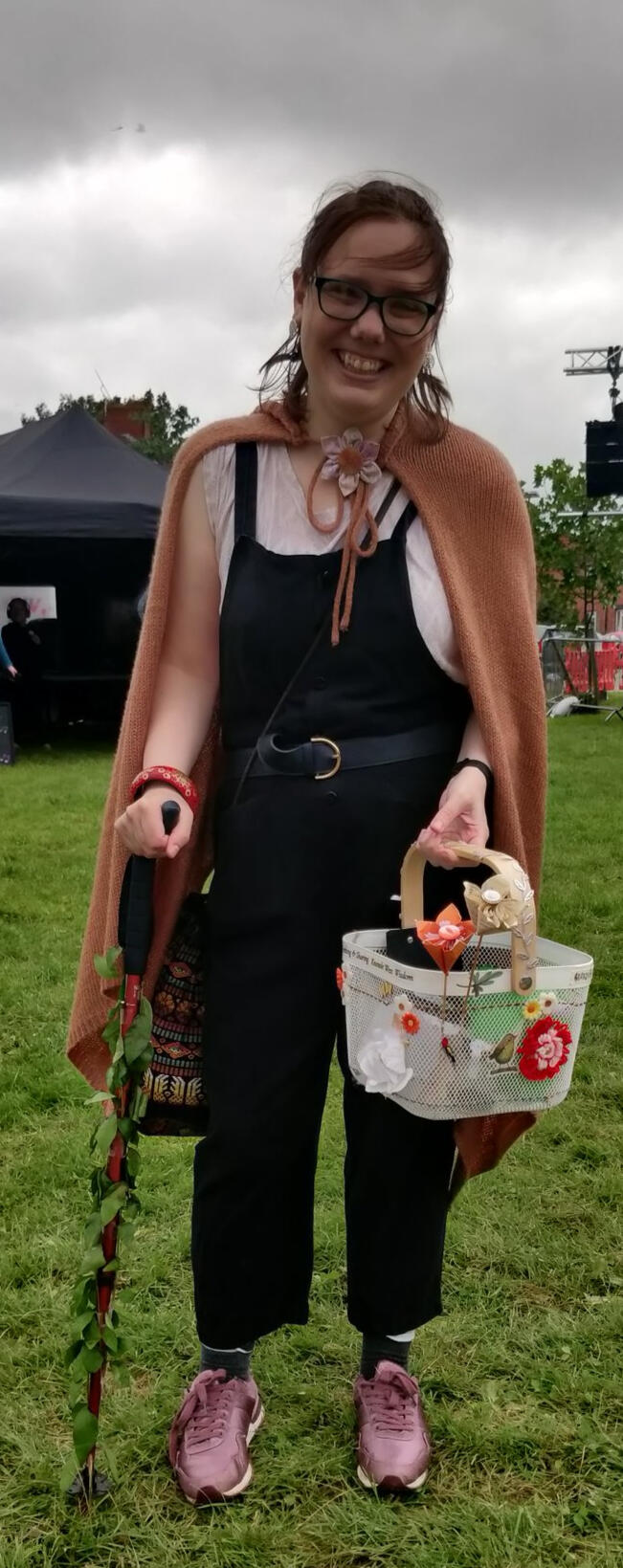
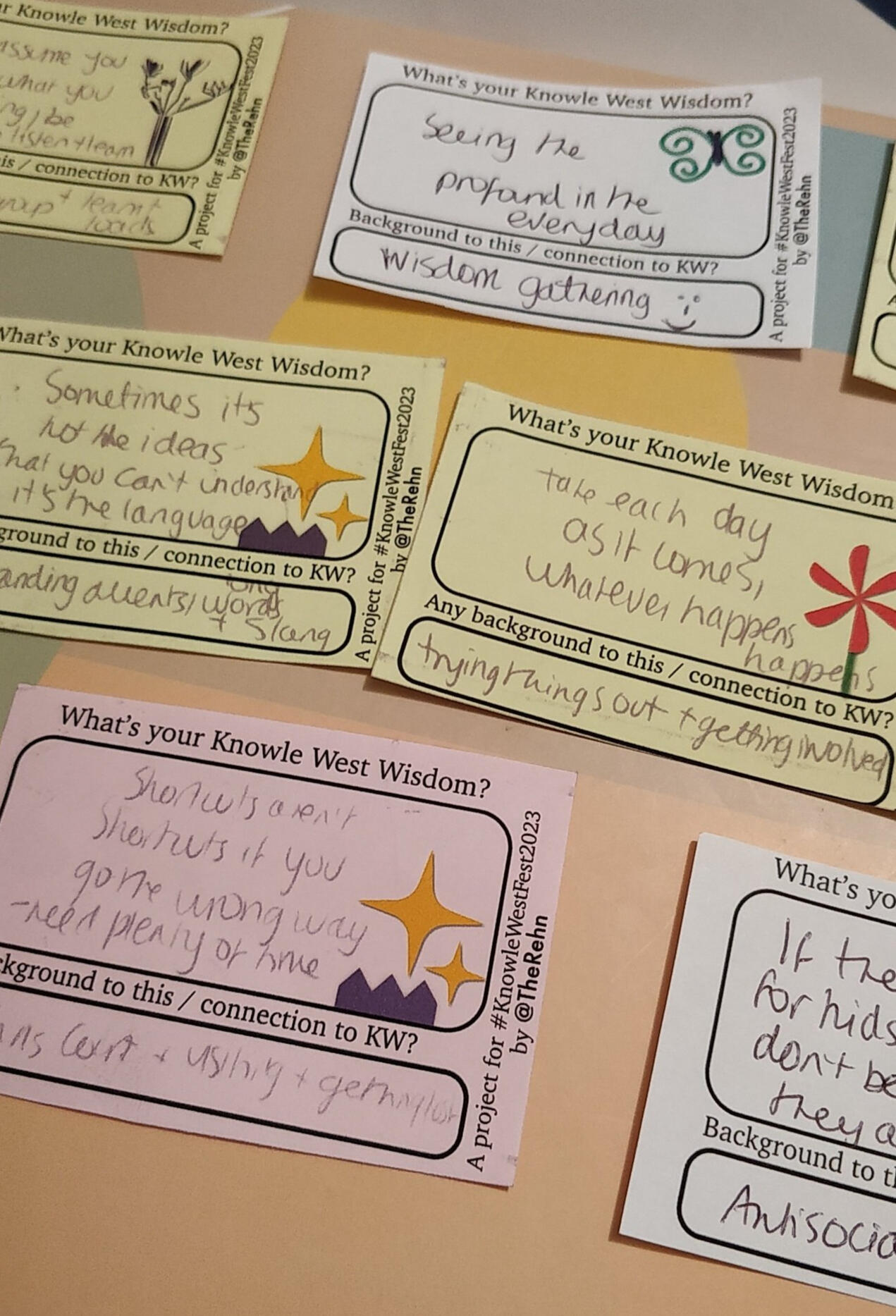
This stemmed from my ongoing explorations of the collective nature of wisdom in comparison to intelligence, considering AI, folk and plant wisdom and considering where wisdom comes from. The style of the wisdom was inspired by proverbs. I choose to be a roving wisdom gatherer to fit within my own access constraints, as it meant I could move around as needed and didn't have to sit on a chair.The slips were printed on carbonless copy paper, so wisdom seekers could take away a piece of wisdom without it being lost. I found gathering the wisdom worked best by drawing out the wisdom in conversation and then deciding how to phrase it collaboratively.
Examples of Wisdom Gathered and Shared
"Don't assume you know what you are doing, be prepared to listen and learn" - from co-leading a parenting group and learning loads.
"See the profound in the everyday" - from discussing the experience of wisdom gathering conversations.
"Sometimes it's not the ideas you can't understand, it's the language" - difficulties understanding accents, long words, slang or jargon.
"Take each day as it comes, whatever happens, happens" - approach to life, leads them to try things out and get involved
"Shortcuts aren't shortcuts if you go the wrong way... allow plenty of time" - Experiences in Inn's Court, people visiting and getting lost, however the power of wandering exploring was acknowledged too 😀